
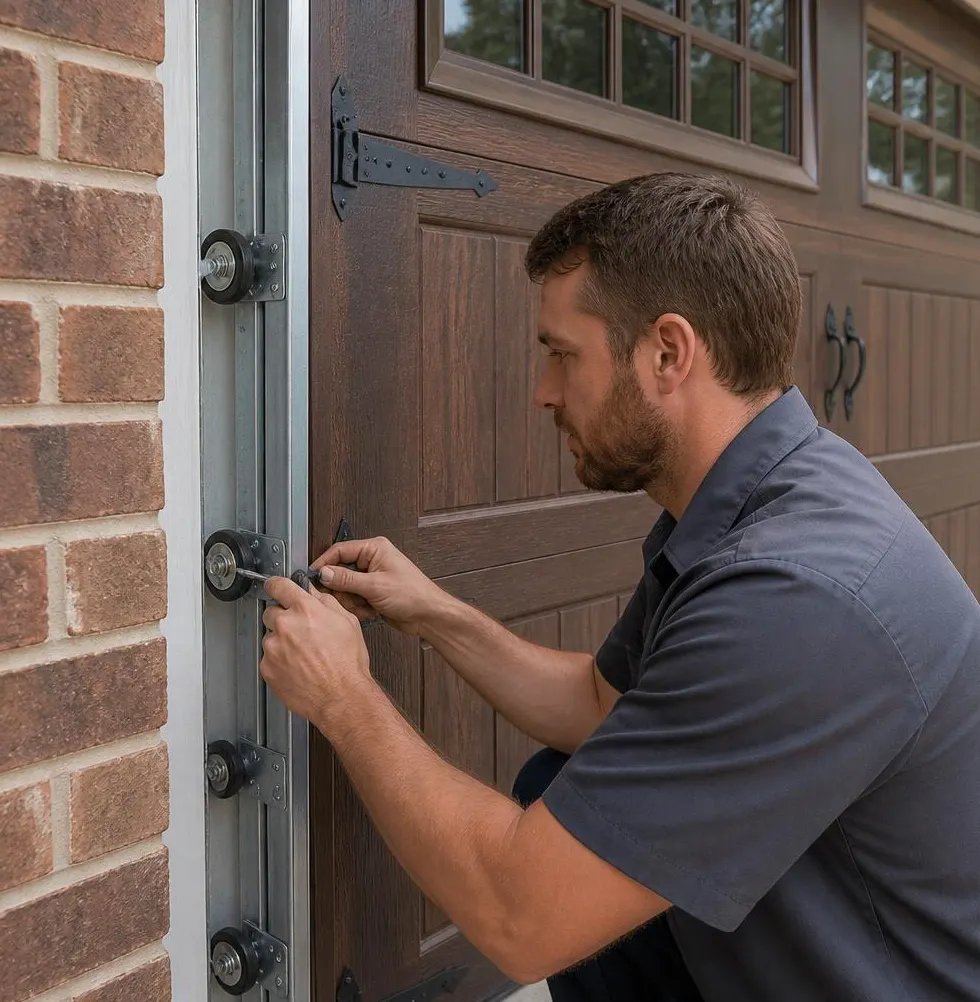
What the Technician Sees
This one comes up more than you'd think in a county with as many converted barns, detached workshops, and home-based contractor garages as this one. A technician gets a call about a 'garage door' that's sagging, grinding, or refusing to close evenly. They show up and find a heavier door than a typical two-car residential setup, on a detached building that used to be a barn or equipment shed, getting opened and closed eight or ten times a day because someone runs a landscaping business or stores a work van and trailer in there. The door and opener were sized and sold as residential equipment, rated for a handful of cycles a day, not the heavier daily workload it's actually seeing. That mismatch is almost always the root of the problem, and it's the exact argument that sends one spouse to Google at ten at night.
It's Not Just a Bigger Version of the Same Door
A residential garage door and a commercial or warehouse overhead door look similar from the driveway, but the engineering underneath is different in ways that matter.
- Panel construction: Residential doors are usually steel, wood, or fiberglass sandwich panels built for insulation and curb appeal. Commercial doors are often heavier-gauge steel, sometimes with reinforced ribs, built to handle more frequent impacts, forklift near-misses, and higher wind loads.
- Torsion spring systems: Residential springs are typically rated for somewhere around 10,000 cycles, which is fine for a door opening four to six times a day. Commercial doors use higher-cycle springs, sometimes rated for 25,000 to 50,000 cycles, because they're expected to open dozens of times a day.
- Track and roller hardware: Commercial setups often use heavier track gauges and ball-bearing rollers instead of the standard nylon rollers found on most residential doors, simply because the door is heavier and moving more often.
- Openers: A 1/2 horsepower residential opener is not built for constant-duty use. Commercial jackshaft or trolley operators are designed for continuous operation and higher torque, and many include safety features like photo-eye sensors and edge sensors that go beyond what's standard on a home garage door.
When someone bolts a residential door and opener onto a building that functions like a small commercial space, the equipment wears out fast, and it usually fails at the worst moment, like during a rush delivery or right before a storm.
Why This Matters More With Local Weather
The weather swings in this part of Delaware put extra stress on any overhead door, but the effect compounds on equipment that's already working harder than it was built for.
Humid Summers
High humidity swells wood panels, and it also accelerates rust on springs, hinges, and track bolts that aren't properly lubricated or sealed. A door cycling many times a day pushes moisture-laden air through the opening more often, so corrosion-prone parts see more exposure.
Icy Winters
Cold makes steel contract and lubricant thicken, which is hard enough on a residential door opening twice a day. On a door opening a dozen times, that stiffness translates into faster wear on rollers, hinges, and the opener's drive system. Ice buildup at the bottom seal is also a bigger issue on heavier commercial-style doors because there's more weight trying to break through it, which can strain the opener or bend the bottom panel.
Heavy Rain and Coastal Storms
Water intrusion at the threshold is a problem for any garage, but a commercial-use door that's opened frequently during a storm, say, for a work truck coming and going, lets in more wind-driven rain than a door that stays shut. Weatherstripping and threshold seals need checking more often on high-cycle doors for exactly this reason.
Maintenance Needs Are Different, Too
Residential doors can usually get by on a seasonal once-over: lubricate moving parts, check the balance, inspect the weatherstripping, tighten loose hardware. A door doing commercial-level duty needs a tighter schedule because the parts are working harder and failing faster.
- Check spring tension and listen for grinding or popping more frequently, not just once or twice a year.
- Inspect cables and rollers for fraying or flat spots, since high-cycle use shows wear sooner.
- Have the opener's force settings and safety sensors tested regularly. A door closing on something because the sensors drifted out of calibration is a bigger liability on a door used constantly.
- Keep an eye on the bottom seal and weatherstripping heading into winter, since a heavier door compresses seals differently than a lighter one.
If a building is functioning like a small commercial space, it's worth asking whether the door and opener should be upgraded to equipment actually rated for that use, rather than continuing to repair residential parts that keep failing under the load.
When to Call Hockessin Garage Door
If a door on a workshop, detached garage, or small business space is cycling several times a day, sagging unevenly, or the opener is straining and overheating, it's time for a proper inspection rather than another quick fix. Hockessin Garage Door can evaluate whether the current setup is actually suited to the workload and recommend a Spring Replacement with higher-cycle springs, or a full Garage Door Opener Repair & Installation using commercial-grade equipment built for frequent use. Catching the mismatch now is cheaper than replacing a cracked panel or a burned-out opener motor later.
If that sounds like the door you've been arguing about, give Hockessin Garage Door a call. We serve Hockessin, Wilmington, Newark, Pike Creek, Greenville, Centreville, Kennett Square, and Landenberg, and we'll tell you straight whether you need a repair or a real upgrade.